Liverpool
Dark Lies the IslandLiverpool is more than a city on the characters’ itineraries: it becomes a place where displacement turns into memory, and where a convivial visit exposes the losses accumulating behind the Real Ale Club’s rituals. The narrator first arrives there alone after his wife leaves him; years later, a club outing brings him back among friends, but the familiar streets cannot restore what time has taken.
The city as refuge after a rupture
In October 1995, while travelling from Leicester toward Northern Ireland with his wife, the narrator was left behind at motorway services outside Ormskirk after an argument. He waited, believing she would return, then found himself alone in a Chinese restaurant, crying over Szechuan beef. A taxi took him into Liverpool, where he sought out a pub and discovered the Ship and Mitre. Its striking row of hand pumps offered an immediate, tangible welcome: he ordered a Beaver Mild from Devon, and a man at the bar advised him against it. Liverpool first enters this thread not as a settled home but as the nearest city where a stranded person can find a pub and a next step.
That arrival later defines the narrator’s own description of himself. Looking back during the Llandudno outing, he calls himself shipwrecked in Liverpool. The metaphor captures both the practical abandonment that brought him there and the way the city became a point of reference in a life redirected by the separation.
A return with the Real Ale Club
The club’s July trip to Llandudno begins at Lime Street in extreme heat. The narrator is serving as both publications officer and outings officer, a combination he recognizes as controversial, and the group sets out to visit recommended pubs. In Llandudno, the heat overwhelms the town: families struggle with the day and children cry. At the Otter, the group settles for St Austell Tribute from a limited selection, while the quality of the pub’s scratchings proves better than expected. The beer is in good condition, and the members assess it on their club’s numerical scale.
The outing also recalls the narrator’s earlier discovery of the Real Ale Club life. At a later stop, television reports beaches crowded with people and traffic in chaos; Billy Stroud consults weather satellites on a public internet machine. The beer turns the narrator inward, back to the 1995 journey, the argument at the services, and the meal he ate alone before taking a taxi to Liverpool. What had seemed an incidental stop becomes the beginning of the story he tells about his place in the club.
From fellowship to accumulated loss
On the return journey, a hurtful remark has unsettled the group. Tom N raises a hand in a gesture of peace, but the narrator can still see the hurt the exchange caused. His thoughts widen from that moment to the friends’ separate hardships: Tom has been through the courts, Everett is described as half mad, Mo is scarred and has lost a testicle, and Big John has been unemployed for eighteen months. Billy Stroud, by contrast, seems content in his own fashion. The narrator places his own Liverpool shipwreck alongside these divergent fates rather than apart from them.
As the train passes terrace houses in the Speke area, the group sees family life through open windows and hears laughter. The scene stands against the narrator’s awareness of death: preparing obituaries for the newsletter has become his grimmest duty, and too many club members have died in their mid-forties. He announces that he is leaving both outings and publications. The decision is not simply a response to a bad day; it follows the weight of recording a community’s losses while continuing to organize its pleasures.
Sentiment, return, and belonging
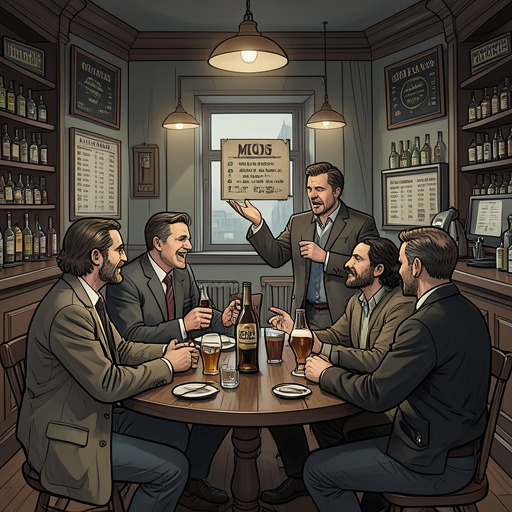
When Mo says he is thinking of earlier days, Liverpool’s effect becomes explicit. The narrator observes that a return to the city quickly makes a person sentimental. Six large men step off at Lime Street in the evening sun, and Tom N suggests the Lion Tavern. The narrator agrees that the Lion is always there. The exchange offers a small ritual of continuity after the strain of the trip: the city supplies a familiar pub even as the people arriving there have changed.
Liverpool’s significance rests on this double movement. It is the place where the narrator was abandoned and began a new chapter, but also the place to which the club can return together, carrying private memories and shared histories. Its streets and pubs provide neither a cure for loss nor a guarantee of belonging; they make both visible, holding the solitary arrival of 1995 beside the later, fragile fellowship of six men at Lime Street.